Helping recycling keep up with plastic production through cheap, fast and green chemistry
New research at Trinity College Dublin is rethinking how plastics are recycled at the molecular level.

Since you began reading this sentence, more than a tonne of new plastic in the form of poly(ethylene terephthalate) (PET) has already entered the global supply chain.
In 2025, worldwide production of virgin PET resin reached 994 kilograms per second, driven largely by demand for packaging. Once discarded, PET can persist for centuries in marine environments, and up to millennia in landfills, while recycling systems struggle to keep pace with the sheer scale and pace of production.
Research led by Prof. Stephen Connon at Trinity College Dublin is tackling an urgent question: how can recycling sustainably keep up with the pace of plastic production? Supported through Research Ireland’s Frontiers for the Future programme, Prof. Connon and his research group are developing new chemical approaches that could help close the gap between how quickly plastic is produced and how effectively it can be recycled.
Today, most PET recycling is mechanical; plastic is collected, sorted, melted down, and reshaped into new products. While effective at industrial scales, this process degrades the plastic over several cycles, limiting how often it can be reused. Chemical recycling offers an alternative, breaking PET down into its molecular building blocks, so it can be remade into pristine PET for any application, from the bottom up. Despite its appeal however, chemical recycling has struggled to gain traction. With virgin PET costing around $1 USD per kilogram, any alternative technology needs to be fast, cheap, and itself sustainable at scale.
Our team is passionate about the design of ever more circular processes – where waste (in this case vegetable oil waste) can not only be repurposed, but can be upcycled into a cheap, sustainable yet powerful potential solution to the much greater environmental headache associated with PET recycling. Using waste to drive the recycling of other waste, without compromising on efficiency, represents an attractive way forward in the search for more sustainable recycling technologies.
– Professor Stephen Connon, Trinity College Dublin
For Prof. Connon and his team, a key challenge has been turning chemical recycling from a promising idea to something that could operate more effectively, cheaply, and at scale. Chemical routes to PET recycling have existed for years, but many rely on expensive, unsustainable or toxic catalysts (materials that speed up chemical processes without being used up themselves), and suffer from long reaction times; limiting their real-world applications. A major focus of the group’s work has been on glycolysis, a process that uses ethylene glycol to break the PET into its original components.
Earlier studies in the field had promoted certain catalysts as ‘sustainable’ and ‘green’, presenting them as viable solutions for PET recycling. However, when the Connon group examined these systems more closely, they identified a clear limitation; while the catalysts were environmentally friendly, their activity was often low. In other words, they were sustainable in principle, but too slow to be useful at scale.
Working off the principle that sustainability only matters if the process is efficient and affordable enough to be used in practice, the group set out to design systems that could meet all of these requirements at once.
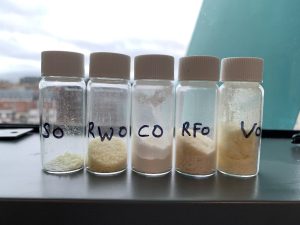
In new work published in January 2026 in RSC Sustainability, the team have since developed an approach that shows PET can be broken down quickly using simple magnesium soaps made from inexpensive, widely available and environmentally benign materials. These soap-based catalysts are produced from common vegetable oils, and the team have even demonstrated that waste cooking oil can be used.
The catalysts are simple to prepare, and outperform the state-of-the-art materials in breaking down PET in many cases. Often, the soap catalyst is used in tiny amounts: just 0.4% of the weight of the plastic is required to achieve rapid and complete recycling – making them realistic candidates for industrial use. As part of this work, Prof. Connon’s group also collaborated with Dr. Kieran Kilcawley and his team at Teagasc to determine which vegetable oils made the best catalyst systems.
By turning one waste stream into part of the solution for another, their research has uncovered chemical recycling methods that are both effective and genuinely sustainable.
Aligned with Research Ireland’s goal to support frontier research with real societal and economic impact, this work is a strong contribution to national and European targets around climate action, sustainable materials, and the circular economy. Prof. Connon’s research demonstrates how fundamental chemistry can deliver practical solutions to some of the most pressing global challenges.
Find out more:
Read the paper in RSC SustainabilityRead the paper in RSC Sustainability Frontiers for the Future programmeFrontiers for the Future programme


